Federated Execution#
Federation enables reactor programs to run across multiple nodes connected by a network. Each node runs a federate—an independent process executing part of the reactor program. The uLF runtime maintains determinism guarantees across the distributed system through careful coordination.
Why Federation?#
Distributed execution is essential for:
- Cyber-physical systems: Sensors and actuators are physically distributed
- Scalability: Workloads too large for a single MCU
- Fault tolerance: Redundant nodes for reliability
- Mixed platforms: Different MCUs for different tasks
The challenge: how do you maintain the reactor model's determinism when reactors communicate over unpredictable networks?
Architecture Overview#
A federated reactor program consists of:
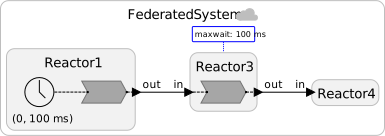
Each federate:
- Runs its own scheduler and event queue
- Maintains its own logical time
- Communicates via network channels
- Coordinates startup and timing
Network Channels#
A network channel represents a physical transport connection between two federates (e.g., a TCP/IP socket, a UART link, or a CoAP endpoint). Multiple LF connections can be multiplexed over a single network channel via Connection Bundles.
Network channels abstract the underlying transport:
typedef enum {
  NETWORK_CHANNEL_TYPE_TCP_IP,
  NETWORK_CHANNEL_TYPE_UART,
  NETWORK_CHANNEL_TYPE_COAP_UDP,
  // ... platform-specific
} NetworkChannelType;

struct NetworkChannel {
  NetworkChannelType type;
  bool (*open)(NetworkChannel* self);
  void (*close)(NetworkChannel* self);
  lf_ret_t (*send)(NetworkChannel* self, const FederatedMessage* msg);
  lf_ret_t (*recv)(NetworkChannel* self, FederatedMessage* msg);
  bool (*is_connected)(NetworkChannel* self);
};
Supported Transports#
| Transport | Platforms | Use Case |
|---|---|---|
| TCP/IP | POSIX, Zephyr, RIOT | Ethernet, WiFi |
| UART | RIOT, Pico | Point-to-point serial |
| CoAP/UDP | RIOT | IoT networks |
| Custom | Any | Specialized hardware |
Channel Modes#
Polled mode: The scheduler explicitly polls for messages:
Async mode: Messages arrive via callbacks:
// Callback registered with network stack
void on_message_received(FederatedMessage* msg) {
  queue_incoming_message(msg);
  platform->notify();  // Wake scheduler
}
Connection Bundles#
Multiple LF connections (logical connections between reactor ports) can be multiplexed over a single network channel (e.g., one TCP/IP socket). Connection bundles group these LF connections together:
struct FederatedConnectionBundle {
  NetworkChannel* net_channel;          // Single network channel (e.g., TCP socket)
  FederatedInputConnection** inputs;    // LF connections receiving data
  size_t inputs_size;
  FederatedOutputConnection** outputs;  // LF connections sending data
  size_t outputs_size;
  serialize_hook* serialize_hooks;
  deserialize_hook* deserialize_hooks;
};
Each bundle:
- Uses one network channel for transport (TCP/IP socket, UART link, CoAP endpoint, etc.)
- Contains multiple LF connections that share this channel
- Handles serialization/deserialization for each LF connection
This multiplexing reduces the number of physical network connections needed between federates.
Federated LF Connections#
LF connections that cross federate boundaries are represented as FederatedInputConnection and FederatedOutputConnection objects.
Federated Input Connection#
Represents an LF input port receiving data from a remote federate:
struct FederatedInputConnection {
  Connection super;
  MUTEX_T mutex;            // Protects concurrent access
  interval_t delay;         // Logical delay on the LF connection
  tag_t last_known_tag;     // Latest tag received from upstream
  interval_t max_wait;      // @maxwait value for this LF connection
};
Federated Output Connection#
Represents an LF output port sending data to a remote federate:
struct FederatedOutputConnection {
  Connection super;
  FederatedFlushReactor flush_reactor;  // fluhes outgoing messages
};
The flush reactor ensures messages are sent at the earliest possible time, reducing network congestion and enabling real-time applications.
Message Format#
Messages use Protocol Buffers (nanopb) for efficient serialization:
message TaggedMessage {
  required Tag tag = 1;
  required int32 conn_id = 2;  // Identifies which LF connection
  required bytes payload = 3 [(nanopb).max_size = 832];
}

message Tag {
  required int64 time = 1;
  required uint32 microstep = 2;
}
The conn_id identifies which LF connection the message belongs to, enabling multiplexing of multiple LF connections over a single network channel.
Tag Acquisition and @maxwait#
The core coordination challenge in federated execution: when can a federate safely advance its logical time?
Problem: A federate at tag T doesn't know if a message with a smaller tag will arrive from an upstream federate.
Solution: The @maxwait annotation controls how long a federate waits for messages from one neighboring federates before advancing to a new tag.
For detailed annotation syntax, see the Annotations Reference.
How @maxwait Works#
Before advancing to a tag, the scheduler checks each federated input connection:
- If
last_known_tag >= next_tag, the input is resolved - proceed immediately - If
last_known_tag < next_tag, the input is unresolved - wait up tomax_wait
// In FederatedEnvironment_acquire_tag()
for each input connection:
    if (last_known_tag < next_tag) {
        // Input is unresolved, need to wait
        additional_sleep = max(additional_sleep, input->max_wait);
    }

if (additional_sleep > 0) {
    wait_until(next_tag.time + additional_sleep);
}
// If sleep is interrupted for example by an incoming message start from the beginning
If a message arrives during the wait, it updates last_known_tag and may allow the federate to proceed early.
sequenceDiagram
    participant A as Federate A
    participant B as Federate B

    Note over B: Wants to advance to T=100ms
    Note over B: last_known_tag from A = 50ms
    Note over B: maxwait = 40ms

    alt Message arrives before maxwait expires
        A->>B: Message with tag=100ms
        Note over B: Update last_known_tag = 100ms
        Note over B: Input resolved, proceed immediately
        B->>B: Advance to T=100ms
    else maxwait expires, no message
        Note over B: Wait until T=100ms + 40ms
        Note over B: Proceed anyway (input still unresolved)
        B->>B: Advance to T=100ms
    end
Applying @maxwait to Federates#
When applied to a federate instantiation, @maxwait sets the baseline wait time for all incoming connections:
federated reactor {
  r1 = new Src()
  @maxwait(0)  // Federate r2 has zero baseline wait time
  r2 = new Dst()
  r1.out -> r2.in
}
Applying @maxwait to Connections#
For finer control, apply @maxwait to individual connections to override the baseline:
federated reactor {
  r1 = new Src(sleep = 0 msec)
  r2 = new Src(sleep = 1 sec)
  @maxwait(0)        // Baseline maxwait for r3 is zero
  r3 = new Dst()
  @maxwait(forever)  // Override: wait indefinitely for r3.in1
  r1.out -> r3.in1
  @maxwait(100 ms)   // Override: wait up to 100ms for r3.in2
  r2.out -> r3.in2
}
@maxwait Values#
| Value | Behavior |
|---|---|
0 | No waiting; advance immediately regardless of unresolved inputs |
<time> | Wait up to the specified duration (e.g., 100 ms, 1 sec) |
forever | Wait indefinitely until a message arrives for the tag |
Safe-To-Process (STP) Violations#
An STP violation occurs when a message arrives for a tag that has already been processed. This is different from @maxwait - the message arrived, but it arrived too late.
When STP Violations Occur#
- Federate B advances to tag T and processes reactions
- Later, a message from Federate A arrives with intended tag T (or earlier)
- The scheduler detects that the message's intended tag is in the past
- This is an STP violation - the message should have been processed at tag T but wasn't
// In Scheduler_schedule_at()
if (lf_tag_compare(event->tag, current_tag) <= 0) {
    return LF_PAST_TAG;  // STP violation!
}

// In FederatedConnectionBundle_handle_tagged_msg()
case LF_PAST_TAG:
    LF_INFO(FED, "Safe-to-process violation! Scheduling at current tag instead.");
    event.tag = current_tag;
    event.tag.microstep++;
    schedule_at(&event);
Handling STP Violations with tardy#
Reactions can detect and handle STP violations using the tardy clause:
reactor Dst {
  input in: int

  reaction(in) {=
    // Normal handling - message arrived on time
    printf("Received on time: %d\n", in->value);
  =} tardy {=
    // STP violation - message arrived late
    printf("Late message received!\n");
    // Take corrective action: use default value, log, etc.
  =}
}
The scheduler checks each reaction before execution:
// In _Scheduler_check_and_handle_stp_violations()
if (port->intended_tag != current_tag) {
    // The port's value was intended for a different tag
    reaction->stp_violation_handler(reaction);  // Call tardy handler
    return true;  // Skip normal reaction body
}
Startup Coordination#
Before execution begins, all federates must agree on a federation start time:
sequenceDiagram
    participant A as Federate A
    participant B as Federate B

    A->>B: StartupHandshakeRequest
    B->>A: StartupHandshakeResponse

    loop Start time negotiation
        A->>B: StartTimeProposal(my_start_time)
        B->>A: StartTimeProposal(my_start_time)
    end

    Note over A,B: Agree on max(proposals) as start time
    Note over A,B: Begin execution
Handshake Protocol#
- Connection establishment: TCP/UART connections opened
- Handshake: Exchange version and configuration info
- Start time negotiation: Agree on a common start time
- Barrier: All federates wait until agreed time
- Begin: Execution starts at agreed time
Transient Federates#
Transient federates can join a running federation dynamically:
sequenceDiagram
    participant T as Transient Federate
    participant R as Running Federate

    T->>R: StartupHandshakeRequest
    R->>T: StartupHandshakeResponse

    T->>R: StartTimeRequest
    R->>T: StartTimeResponse(current_time + offset)

    T->>R: JoiningTimeAnnouncement
    Note over T: Begin execution at joining time
The primariy use-case if for letting failed or crashed federates to join back into the federation. But also other patterns could be realized with this mechanism.
Clock Synchronization#
Physical clocks on different nodes, especially microcontrollers, drift and are not synchronized. The uLF runtime can synchronize them.
struct ClockSyncService {
  instant_t offset;      // Local clock offset from reference
  instant_t uncertainty; // Synchronization uncertainty

  void (*sync)(ClockSyncService* self);
  instant_t (*adjust)(ClockSyncService* self, instant_t local_time);
};
Synchronization Protocol#
sequenceDiagram
    participant A as Federate A (Reference)
    participant B as Federate B

    B->>A: ClockSyncRequest(T1=local_send_time)
    Note over A: Receive at T2
    A->>B: ClockSyncResponse(T2, T3=local_send_time)
    Note over B: Receive at T4

    Note over B: offset = ((T2-T1) + (T3-T4)) / 2
    Note over B: Apply offset to local clock
When to Use#
- Required: When STP bounds are tight relative to clock drift
- Optional: When physical timing is loose or nodes share a clock source
- Disabled: For testing or when using logical time only
Federated Environment#
The federated environment extends the base environment:
struct FederatedEnvironment {
  Environment super;
  FederatedConnectionBundle** bundles;
  size_t bundles_size;
  StartupCoordinator* startup_coordinator;
  ClockSyncService* clock_sync;

  lf_ret_t (*acquire_tag)(FederatedEnvironment* self, tag_t tag);
  void (*send_messages)(FederatedEnvironment* self);
};
The acquire_tag function implements the @maxwait mechanism, potentially waiting for unresolved federated inputs before advancing to the requested tag.
Example: Two-Federate System#
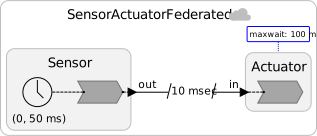
Configuration:
federated reactor System {
  a = new Sensor() at FederateA;
  b = new Actuator() at FederateB;

  a.out -> b.in after 10ms;  // 10ms network delay budget
}
Configuring Network Interfaces#
Federates communicate through network channels derived from interface annotations. The configuration involves two steps:
- Define interfaces on each federate using
@interface_*annotations - these are translated by the code generator into network channels - Bind connections to interfaces using
@link- this tells the code generator which network channel should carry each LF connection
For the complete list of interface annotations, see the Annotations Reference.
@interface_* Annotations#
Each @interface_* annotation defines a named network interface on a federate. The annotation is placed before the federate instantiation:
Available interface types:
| Annotation | Use Case |
|---|---|
@interface_tcp | TCP/IP over Ethernet or WiFi |
@interface_uart | Serial communication |
@interface_coap | CoAP/UDP for IoT networks |
@interface_s4noc | Network-on-chip for Patmos |
@interface_custom | User-defined protocols |
@link Annotation#
The @link annotation binds an LF connection to specific network interfaces. It specifies which interface on the sender (left) and receiver (right) should be used:
TCP/IP Example#
federated reactor {
  // Define TCP interface on sender federate
  @interface_tcp(name="if1", address="127.0.0.1")
  r1 = new Src()

  // Define TCP interface on receiver federate
  @interface_tcp(name="if1", address="127.0.0.1")
  r2 = new Dst()

  // Bind LF connection to network interfaces (r2 acts as TCP server on port 1042)
  @link(left="if1", right="if1", server_side="right", server_port=1042)
  r1.out -> r2.in  // This LF connection will use the TCP channel
}
CoAP/UDP Example#
For IoT networks with constrained devices:
federated reactor {
  @interface_coap(name="if1", address="fe80::44e5:1bff:fee4:dac8")
  r1 = new Src()

  @interface_coap(name="if1", address="fe80::8cc3:33ff:febb:1b3")
  r2 = new Dst()

  @link(left="if1", right="if1")
  r1.out -> r2.in
}
Custom Interface Example#
For specialized hardware or protocols:
federated reactor {
  @interface_custom(name="MyInterface", include="my_interface.h", args="1")
  r1 = new Src()

  @interface_custom(name="MyInterface", include="my_interface.h", args="2")
  r2 = new Dst()

  r1.out -> r2.in
}
Best Practices#
@maxwait Tuning#
- Set
@maxwaitslightly larger than worst-case network latency - Too small: risk of STP violations when messages arrive late
- Too large: unnecessary waiting before advancing tags
- Use
@maxwait(forever)only when messages are guaranteed to arrive - Use
@maxwait(0)for non-critical inputs where occasional late messages are acceptable
Handling Late Messages#
- Always implement
tardyhandlers for reactions on federated inputs - In
tardyhandlers: log violations, use default values, or trigger recovery - Consider whether a late message should be processed or dropped
Network Reliability#
- TCP for reliable delivery
- UDP/CoAP for low-latency with application-level acks
- UART for simple point-to-point
Error Handling#
- Implement reconnection logic
- Handle message loss gracefully
- Log violations for debugging
- Use
tardyhandlers to gracefully degrade under network failures