Redundant Picos#
A fault-tolerant flight controller using federated uLF runtime execution across multiple Raspberry Pi Pico boards connected by UART.

Overview#
This project demonstrates hardware redundancy and automatic leader election using the uLF runtime's peer-to-peer federated execution on Raspberry Pi Pico microcontrollers. Multiple Pico boards form a ring network over UART and independently agree on which node is the current leader. The leader aggregates sensor readings from all nodes and drives the actuators; if it crashes, the remaining nodes elect a new leader without any external coordinator.
The project was presented at the Flight Software Workshop 2025.
Architecture#
Three nodes are connected in a ring. Each node has a left and a right UART neighbor. All communication is peer-to-peer — there is no central RTI. Each node runs an identical reactor program; the my_id, left, and right parameters are the only per-node configuration.
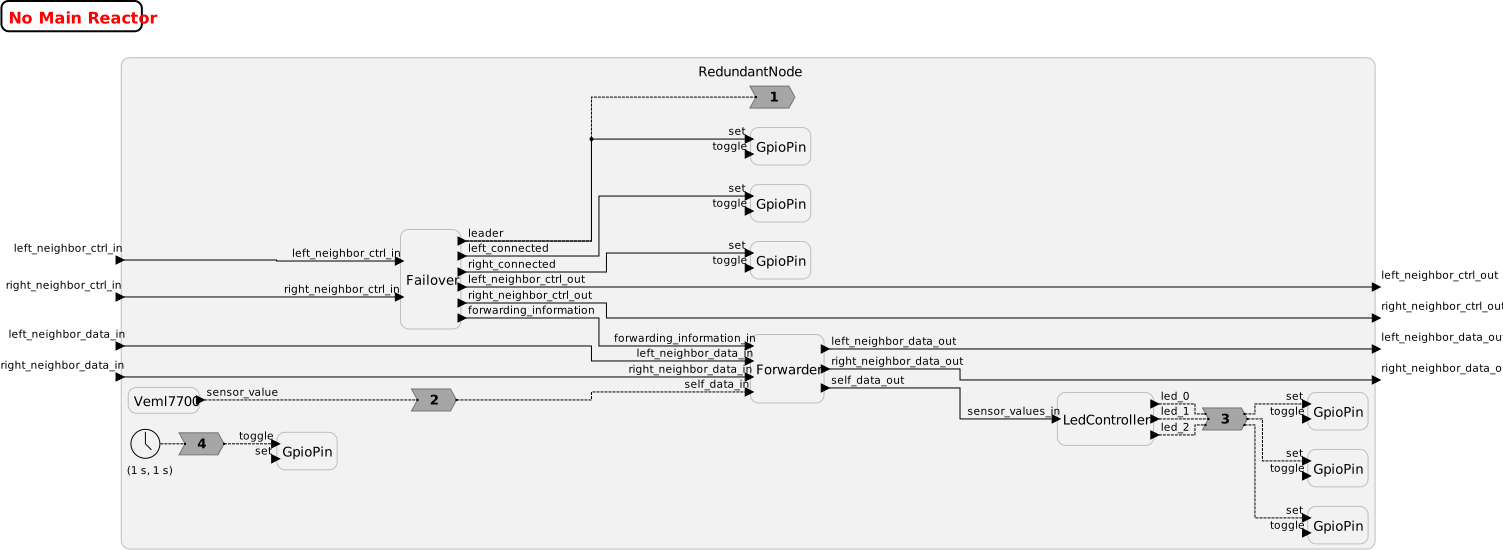
Shared Types#
All nodes share two types defined in common.h:
// Routing decision made by the Failover reactor
typedef enum {
    ForwardLeft  = 1,
    ForwardRight = 2,
    ForwardSelf  = 3,
} ForwardInformation;

// Sensor reading with its originating node ID
typedef struct {
    int source;
    int value;
} FederatedData;
Reactor Breakdown#
Failover — Distributed Leader Election#
Failover implements a simple, decentralized fault-detection and leader-election algorithm using a visibility table: a 3×3 boolean matrix where visibility_table[i*3 + j] means node i can see node j.
Each node periodically broadcasts its row of the visibility table to both neighbors (ping_neighbors timer). When a message arrives, the node updates the sender's row and records the arrival time. If no message arrives from a neighbor within ASSUME_DEAD (750 ms), the corresponding entry is set to false.
reactor Failover(my_id: int = 0, left: int = 1, right: int = 2,
                 offset: interval_t = 100msec) {

    timer ping_neighbors(offset, 500msec);
    timer perform_failover(1sec, 500msec);

    state visibility_table: bool[9];
    state last_received: instant_t[2]; // left, right

    reaction (ping_neighbors) -> left_neighbor_ctrl_out, right_neighbor_ctrl_out {=
        instant_t now = env->get_physical_time(env);

        // Mark neighbors as dead if last heartbeat was too long ago
        visibility_table[my_id*3 + left]  = (now - last_received[0]) <= ASSUME_DEAD;
        visibility_table[my_id*3 + right] = (now - last_received[1]) <= ASSUME_DEAD;
        visibility_table[my_id*3 + my_id] = true;

        // Broadcast own row to both neighbors
        NeighborInformation info;
        memcpy(info.federates, &visibility_table[my_id*3], 3 * sizeof(bool));
        lf_set(left_neighbor_ctrl_out,  info);
        lf_set(right_neighbor_ctrl_out, info);
    =}
The leader election runs every 500 ms. Node 0 is elected leader unless it is considered dead by both other nodes, in which case node 1 takes over:
    reaction (perform_failover) -> leader, forwarding_information, ... {=
        // A node is online if at least one neighbor can see it
        online[0] = visibility_table[1*3+0] || visibility_table[2*3+0];
        online[1] = visibility_table[0*3+1] || visibility_table[2*3+1];
        online[2] = visibility_table[0*3+2] || visibility_table[1*3+2];
        online[my_id] = true; // always consider self online

        int leader_index = (!online[0] && online[1] && online[2]) ? 1 : 0;

        if (leader_index == my_id) {
            lf_set(leader, true);
            lf_set(forwarding_information, ForwardSelf);
        } else {
            lf_set(leader, false);
            // Route data towards the leader, going around a dead link if needed
            lf_set(forwarding_information,
                   leader_is_on_left && left_connected  ? ForwardLeft  :
                   leader_is_on_right && right_connected ? ForwardRight :
                   /* detour */                            ForwardRight);
        }
    =}
Forwarder — Data Routing#
Forwarder routes sensor data according to the ForwardInformation decision made by Failover. It has three input sources (left neighbor, right neighbor, self) and three output sinks. On each event it forwards the payload in exactly one direction:
reactor Forwarder {
    input  forwarding_information_in: ForwardInformation;
    input  left_neighbor_data_in:  FederatedData;
    input  right_neighbor_data_in: FederatedData;
    input  self_data_in:           FederatedData;
    output left_neighbor_data_out:  FederatedData;
    output right_neighbor_data_out: FederatedData;
    output self_data_out:           FederatedData;

    reaction (left_neighbor_data_in) -> ... {=
        switch (forwarding_information) {
            case ForwardLeft:  lf_set(left_neighbor_data_out,  value); break;
            case ForwardRight: lf_set(right_neighbor_data_out, value); break;
            case ForwardSelf:  lf_set(self_data_out,           value); break;
        }
    =}
    // identical reactions for right_neighbor_data_in and self_data_in
}
LedController — Sensor Fusion#
LedController accumulates FederatedData readings from any source, then on a periodic timer computes the average of all readings received since the last tick and drives three LEDs at thresholds 150, 300, and 500 lux:
reactor LedController(rate: interval_t = 250msec) {
    input  sensor_values_in: FederatedData;
    output led_0: bool;
    output led_1: bool;
    output led_2: bool;

    state available: bool[3];
    state values:    int[3];
    timer t(250msec, rate);

    reaction (sensor_values_in) {=
        available[sensor_values_in->value.source] = true;
        values[sensor_values_in->value.source]    = sensor_values_in->value.value;
    =}

    reaction (t) -> led_0, led_1, led_2 {=
        float avg = 0; int count = 0;
        for (int i = 0; i < 3; i++) {
            if (available[i]) { avg += values[i]; count++; available[i] = false; }
        }
        if (count == 0) return;
        avg /= count;
        lf_set(led_0, avg > 150.0);
        lf_set(led_1, avg > 300.0);
        lf_set(led_2, avg > 500.0);
    =}
}
RedundantNode — Composition#
RedundantNode wires the four reactors together and exposes the inter-federate ports at its boundary. The only GPIO-driving reaction guards actuator output behind the leader flag — non-leaders run all the same logic but never write to the center LEDs:
reactor RedundantNode(my_id: int = 0, left: int = 1, right: int = 2,
                      offset: interval_t = 10msec) {

    failover  = new Failover(my_id=my_id, left=left, right=right, offset=offset);
    forwarder = new Forwarder();
    veml7700  = new Veml7700(rate=500msec);      // light sensor
    controller = new LedController(rate=500msec);

    // Status LEDs wired directly from Failover outputs
    failover.leader          -> gpio_leader.set;
    failover.left_connected  -> gpio_left.set;
    failover.right_connected -> gpio_right.set;

    // Sensor pipeline: read → tag with own ID → route → accumulate → drive LEDs
    veml7700.sensor_value -> forwarder.self_data_in  // via reaction (adds source ID)
    forwarder.self_data_out -> controller.sensor_values_in;

    // Actuators: only the leader drives the center LEDs
    reaction (controller.led_0, controller.led_1, controller.led_2)
        -> gpio_center_0.set, gpio_center_1.set, gpio_center_2.set {=
        if (self->leader) {
            lf_set(gpio_center_0.set, controller.led_0->value);
            lf_set(gpio_center_1.set, controller.led_1->value);
            lf_set(gpio_center_2.set, controller.led_2->value);
        }
    =}

    // Federated ports passed through to/from neighbors
    left_neighbor_data_in  -> forwarder.left_neighbor_data_in;
    right_neighbor_data_in -> forwarder.right_neighbor_data_in;
    forwarder.left_neighbor_data_out  -> left_neighbor_data_out;
    forwarder.right_neighbor_data_out -> right_neighbor_data_out;
    failover.left_neighbor_ctrl_out   -> left_neighbor_ctrl_out;
    // ... (symmetric for right side)
}
Federation Configuration#
FlightControllerReal.lf instantiates three RedundantNode federates and wires them over UART. Each federate is configured entirely through annotations — there is no target { } property block.
target uC {
    platform: rp2040,
    logging: INFO,
    clock-sync: on
}

federated reactor {
    // Node 0 — grandmaster clock, uses uart1 for its right neighbor
    @interface_uart(name="uart1", uart_device=1, baud_rate=57600,
                    data_bits=8, parity="UART_PARITY_EVEN", stop_bits=1)
    @clock_sync(grandmaster=true, period=3500000000, max_adj=512000, kp=0.5, ki=0.1)
    node_0 = new RedundantNode(my_id=0, left=2, right=1, offset=10msec);

    // Node 1 — uses uart0 for its left neighbor (node 0)
    @interface_uart(name="uart0", uart_device=0, baud_rate=57600,
                    data_bits=8, parity="UART_PARITY_EVEN", stop_bits=1)
    @clock_sync(grandmaster=false, period=3500000000, max_adj=512000, kp=0.5, ki=0.1)
    node_1 = new RedundantNode(my_id=1, left=0, right=2, offset=20msec);

    // Control channel: node_0 right ↔ node_1 left, with 50ms logical delay
    @link(left="uart1", right="uart0")
    @buffer(10)
    node_0.right_neighbor_ctrl_out -> node_1.left_neighbor_ctrl_in after 50msec;

    // Data channel: node_0 right ↔ node_1 left
    @link(left="uart1", right="uart0")
    @buffer(10)
    node_0.right_neighbor_data_out -> node_1.left_neighbor_data_in after 50msec;

    // Symmetric return channels
    @link(left="uart0", right="uart1")
    @buffer(10)
    node_1.left_neighbor_ctrl_out -> node_0.right_neighbor_ctrl_in after 50msec;

    @link(left="uart0", right="uart1")
    @buffer(10)
    node_1.left_neighbor_data_out -> node_0.right_neighbor_data_in after 50msec;
}
Notable uLF runtime features in use:
@interface_uart— defines a UART transport; no central RTI is needed@link— binds an LF connection to a named interface, multiplexing control and data over the same physical UART@buffer(10)— reserves static buffer space for up to 10 in-transit messages per connection@clock_sync— runs a PTP-like synchronisation loop so node clocks track node_0 (the grandmaster) without a GPS or NTP serverafter 50msec— adds a logical delay to account for UART transmission latency
Building and Flashing#
Clone the repository and build each federate separately:
Flash node 0:
cmake -Bbuild . -DLF_MAIN=FlightControllerReal -DFEDERATE=node_0
cmake --build build
sudo picotool load -x build/LF_MAIN.elf
Flash node 1 (repeat with DFEDERATE=node_1 on a second Pico):
cmake -Bbuild . -DLF_MAIN=FlightControllerReal -DFEDERATE=node_1
cmake --build build
sudo picotool load -x build/LF_MAIN.elf
Run the sensor self-test on a single board: