Design Philosophy#
micro-LF brings the reactor model of computation to resource-constrained embedded systems. This section explains the core concepts, design decisions, and trade-offs that shape the runtime.
Why micro-LF?#
Concurrent programming on embedded systems is notoriously difficult. Traditional approaches—bare-metal interrupts, RTOS tasks, or event loops—require developers to manually manage synchronization, timing, and communication. This leads to:
- Race conditions from unprotected shared state
- Deadlocks from improper lock ordering
- Non-determinism that makes debugging nearly impossible
- Timing bugs that only manifest under specific conditions
The reactor model offers a fundamentally different approach: deterministic concurrency through logical time. Instead of reasoning about physical time and thread interleavings, developers define reactive components that respond to events at well-defined logical instants.
The Reactor Model#
At its core, the reactor model structures programs as a composition of reactors—isolated components that communicate through well-defined ports and connections. Each reactor contains:
- State that is private and encapsulated
- Reactions that execute atomically in response to triggers
- Ports for typed communication with other reactors
- Timers and Actions for scheduling future events
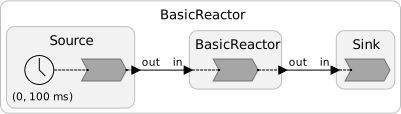
This model is implemented in the Lingua Franca coordination language, and the uLF runtime serves as the execution runtime for embedded targets.
Design Principles#
1. Determinism Through Logical Time#
Every event in the uLF runtime occurs at a logical time, independent of when it physically executes. Events at the same logical time are ordered by microsteps, providing a total ordering of all events. This means:
- Given the same inputs, the program produces the same outputs
- Debugging is reproducible—you can replay executions exactly
- Testing is meaningful—no flaky tests from timing variations
2. Resource Efficiency#
Embedded systems have tight memory and CPU constraints. The uLF runtime is designed with this in mind:
- No dynamic allocation at runtime—all memory is pre-allocated
- Minimal dependencies—just the C standard library (and nanopb for federation)
- Compile-time configuration—unused features have zero overhead
3. Composability#
Complex systems are built from simpler parts. The uLF runtime supports:
- Hierarchical reactors—reactors can contain child reactors
- Typed connections—ports enforce type compatibility
- Modular design—reactors are reusable building blocks
4. Platform Independence#
The same reactor program can run on different targets:
- POSIX (Linux, macOS) for development and testing
- Zephyr RTOS for production embedded deployments
- RIOT OS for IoT devices
- Raspberry Pi Pico for hobbyist and educational use
- FreeRTOS for existing RTOS-based projects
- Bare metal for maximum control
A thin platform abstraction layer provides timing, synchronization, and I/O primitives for each target.
5. Distribution Without Sacrificing Correctness#
The uLF runtime supports federated execution—distributing reactors across multiple nodes connected by networks. The runtime maintains determinism guarantees through:
- Safe-To-Process (STP) constraints that bound waiting time
- Clock synchronization to align physical clocks
- Startup coordination to ensure all nodes begin together
What's Next?#
Explore the detailed documentation for each aspect of the design:
-
The Reactor Model
Understand reactors, reactions, ports, and connections—the building blocks of micro-LF programs.
-
Time and Determinism
Learn how logical time, tags, and microsteps enable deterministic concurrent execution.
-
Scheduling
Explore the event-driven scheduler that executes reactor programs.
-
Memory Management
Understand the pre-allocation strategy that makes the uLF runtime suitable for embedded systems.
-
Platform Abstraction
See how the uLF runtime adapts to different operating systems and hardware.
-
Federated Execution
Distribute reactors across multiple nodes while maintaining correctness.